Dangote shares on the NSE: what Kenyans should check before buying.
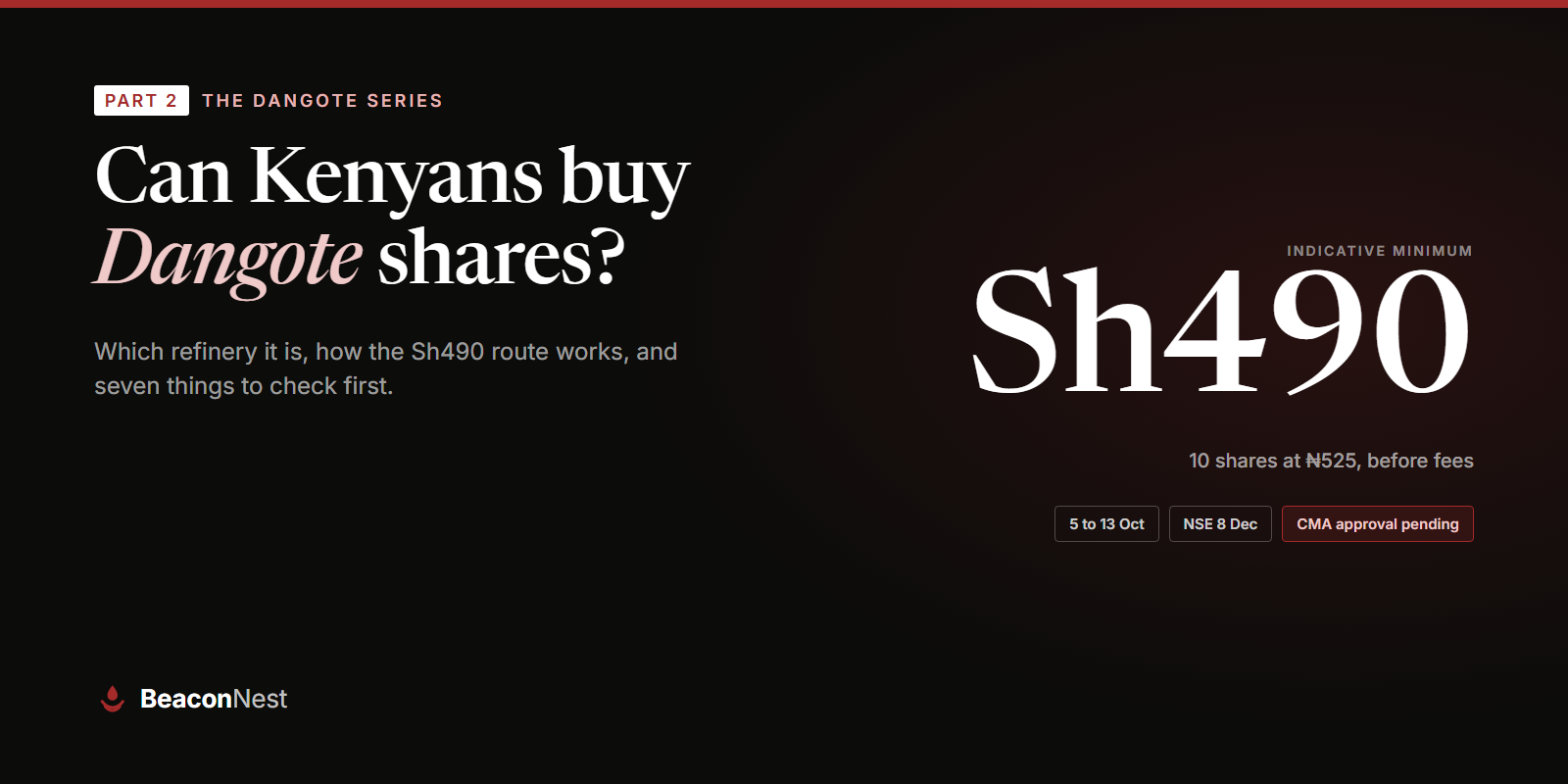
For the first time, Kenyans may be able to own a piece of a Dangote refinery without leaving Nairobi. Here is what is actually on offer, how it would work, and the questions to ask before you put money in.
The day after Dangote broke ground in Lamu, many Kenyans are asking the same question.
“Can I buy Dangote shares?”
The honest answer is: possibly, soon, and only through the right route. Here is what you need to know first.
As reported up to 30 September 2026. Terms depend on final regulatory approval. Sources at the end of this article.
First: which refinery are we talking about?
This is the most important point, and the one most likely to be misunderstood.
The shares on offer are in Dangote Petroleum Refinery and Petrochemicals, the refinery in Lagos, Nigeria. They are not shares in the new Lamu refinery.
Dangote has said the Lamu refinery should eventually be listed on the Nairobi Securities Exchange. That is a stated intention. There is no Lamu share offer today, and anyone selling you “Lamu refinery shares” right now is not offering you something real.
What is being offered?
In Nigeria, the Lagos refinery is running an initial public offering of about 4.1 billion shares at ₦525 each. The offer opened on 14 September and is scheduled to close on 13 October 2026. Kenyan reports put its size at around Sh207 billion.
Reports say the money raised will help fund an expansion of the Lagos refinery towards 1.4 million barrels a day, roughly double its design capacity.
For Kenyans, the offer would come through a structure called a Global Depositary Receipt, or GDR.
What is a GDR, in plain English?
A GDR is a certificate that represents shares held in another country. The real Nigerian shares sit with a custodian. A receipt backed by those shares is created in Kenya, listed on the NSE and traded in Kenyan shillings.
As reported, the chain would work like this:
You → a licensed Kenyan broker → Renaissance Capital → Nigerian IPO allocation → shares held by Stanbic → GDRs issued → traded on the NSE
You would need a CDS account with a licensed stockbroker, the same account used to hold any NSE-listed share.
Where does approval stand?
As of late September, reports said the offer had not yet been approved as a public offer in Kenya. The Capital Markets Authority and the NSE were working on a route that would let Kenyans take part before the Nigerian offer closes.
Some firms have run separate private arrangements with much higher minimums. One was reported at over Sh258,000, closing on 7 October. Those are aimed at larger investors, not the general public.
Details may change quickly this week. Always confirm the current position with a licensed broker before sending money.
Seven things to check before you buy
-
Is the route approved?
Ask your broker whether the Kenyan offer has CMA approval, and ask to see the offer document. No approval, no public offer.
-
Is your broker licensed?
Check the firm against the CMA’s list of licensed stockbrokers and investment banks. Deal with the firm, not with an individual.
-
What exactly will you own?
A receipt backed by Nigerian shares, not the shares themselves. Ask how voting, dividends and corporate actions pass through to GDR holders.
-
What are the fees?
Brokerage, custody and administration costs can take a real bite out of small investments. Ask for the total cost in shillings.
-
Are you comfortable with currency risk?
The underlying shares are priced in naira. If the naira weakens against the shilling, your GDR can lose value even if the share price holds. The naira has been volatile in recent years.
-
Can you sell when you want to?
Trading on the NSE is targeted for December. A thinly traded GDR can be hard to sell at a fair price. Think of this as a long-term holding.
-
How much can you afford to lock away?
A large IPO can be oversubscribed, which means you may receive fewer shares than you applied for. Never invest money you will need soon, or borrow to buy.
Why this matters beyond one share offer
Whatever happens with this particular offer, the idea behind it is significant.
For most of our history, the big productive assets built in Africa, refineries, ports, power plants, have been owned by governments and foreign investors. An ordinary saver in Nairobi could watch them being built, but could not own a piece.
Listings like this change that conversation. So does the growing interest in structured, shared ownership of real estate, from REITs to the tokenization ideas we have written about before.
The question for Kenyan savers is no longer only “what should I buy?” It is “what should I own, and what do I actually understand?”
Shares, land and buildings carry very different risks. The right mix depends on your time horizon, your income and how much of your money you need to reach quickly.
At Beacon Nest, our world is property: land, homes and, increasingly, apartment developments for ordinary Kenyans. We will keep writing about the wider investment landscape because our readers, at home and in the diaspora, are weighing all of it together.
Owning a piece of Africa’s infrastructure is becoming possible. Understanding exactly what you own is still your job.
Get the next one in your inbox.
Research and commentary on Kenyan property, infrastructure and investment. One email when something new is published. No spam.
Not sent
Please try again, or email info@beaconnesttradings.com.
You are subscribed.
The next Beacon Nest Insight will come straight to your inbox.
- Part 1Dangote in Lamu: why it is a corridor story
- Part 2Dangote shares on the NSE: what Kenyans should check before buyingYou are reading this
- Part 3Where will the crude come from?
- Part 460,000 jobs: where will the workforce live?
- Part 5What happened around the Lagos refinery, and what Kenya can learn
This article explains publicly reported information as of 30 September 2026. It is not investment advice, a recommendation to buy or sell any security, or an offer of any security. Beacon Nest Tradings Limited is not a licensed stockbroker, investment bank or investment adviser and has no role in this share offer. Confirm current terms with a firm licensed by the Capital Markets Authority and take independent advice before investing.