Where will the crude come from? The question behind the Lamu refinery.
A 700,000 barrel-a-day refinery needs 700,000 barrels of crude every day. East Africa does not produce that yet. So where will it come from, and does it matter?
Every refinery is a simple machine at heart. Crude goes in. Petrol, diesel, jet fuel and other products come out.
Which means every refinery lives or dies on two questions: can it get crude reliably, and can it sell what it makes at a profit?
For the Lamu refinery, the second question looks strong. The first is where most of the public debate is focused.
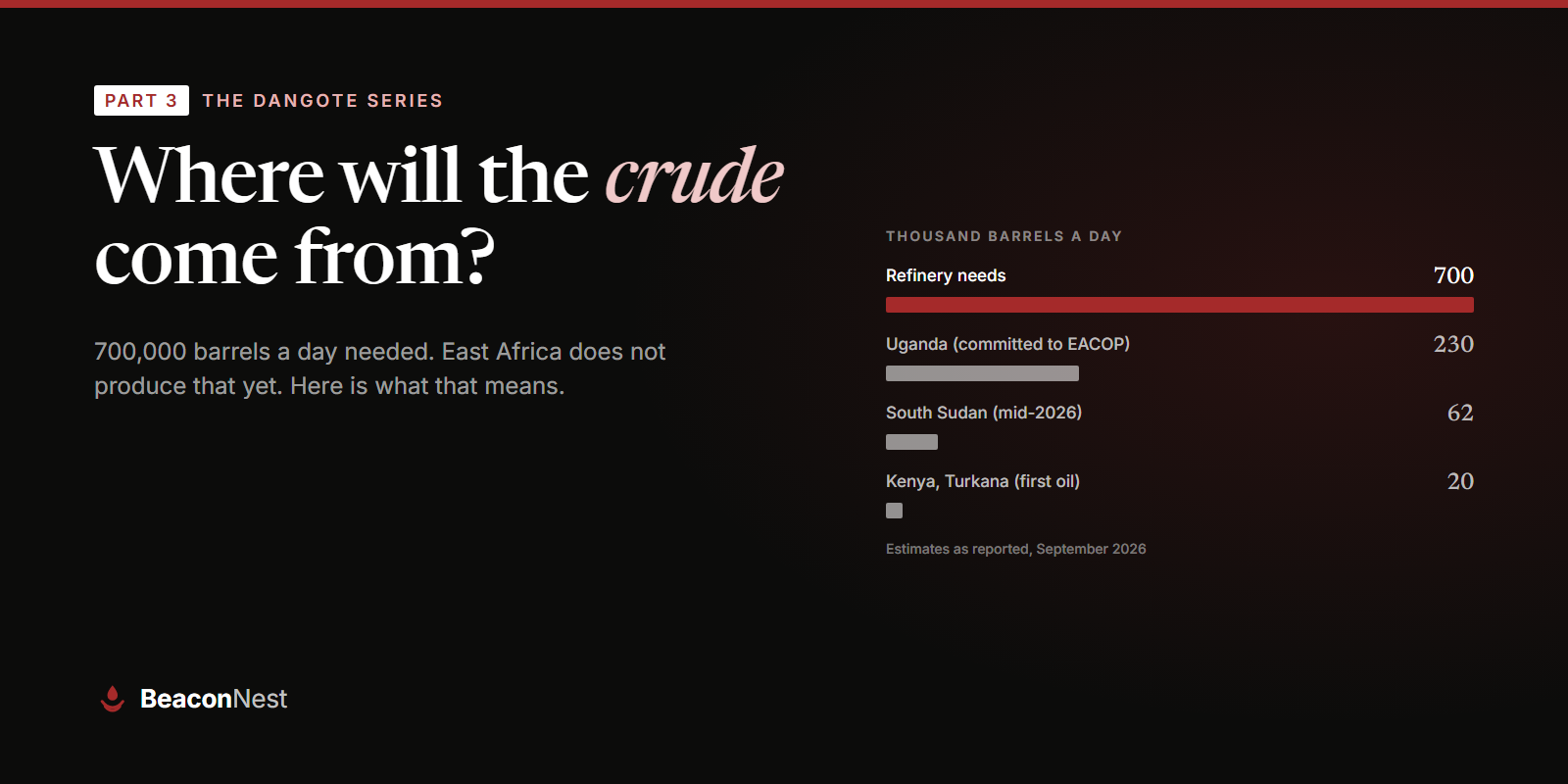
Estimates as reported up to 30 September 2026. Sources at the end of this article.
The arithmetic
Dangote has said he hopes to source around 600,000 barrels a day from within East Africa, from Kenya, Uganda and South Sudan.
Today, that crude does not exist in the volumes needed, or it is already spoken for. Let us take each source in turn.
Kenya: Turkana is coming, slowly
Kenya’s oil sits in the South Lokichar basin in Turkana, discovered more than a decade ago. It is only now approaching commercial production.
First production is expected to start small, at around 20,000 barrels a day. Projections for the early 2030s range from about 50,000 to 120,000 barrels a day, depending on the source.
And there is a distance problem. Turkana is roughly 825 kilometres from Lamu. Without a pipeline, Kenyan crude cannot reliably feed the refinery. A Lokichar to Lamu pipeline has been part of the LAPSSET plan for years, but it has not been built.
Uganda: the oil is heading the other way
Uganda is expected to produce around 230,000 barrels a day at plateau. But that crude is already committed.
The East African Crude Oil Pipeline, about 1,443 kilometres long, is built to carry it south to the Tanzanian port of Tanga, the same town Dangote considered and passed over for his refinery. Uganda’s own planned 60,000 barrel-a-day refinery at Kabaale would also have first call on its crude.
So Ugandan crude reaching Lamu would require new agreements and, most likely, new infrastructure.
South Sudan: large reserves, difficult routes
South Sudan once produced around 150,000 barrels a day. Conflict and pipeline problems through Sudan have cut that sharply, to around 60,000 to 65,000 barrels a day in mid-2026.
A pipeline linking South Sudan to Lamu is one of LAPSSET’s longest-standing ideas. It remains, in Reuters’ words, a distant prospect.
The answer that is already available: the ocean
This is the part that is often missed. Lamu is a deep-water port. A coastal refinery does not need a pipeline to receive crude. It can import it by ship from the Middle East, West Africa or anywhere else with the right grade at the right price.
That is not a theoretical option. Dangote’s own Lagos refinery, built in one of Africa’s largest oil-producing countries, has relied heavily on imported crude since it started.
Regional crude is the upside. Imported crude is the base case.
The refinery can run without East African pipelines. Those pipelines would make it cheaper to run, tie the region together and create a second wave of infrastructure.
So does the crude question matter?
Yes, but perhaps not in the way the headlines suggest.
The question is less “will the refinery have crude?” and more “how profitable will it be, and how much regional infrastructure will follow?”
- Imported crude means shipping costs and exposure to global prices
- Regional crude would cut costs, but needs pipelines that do not exist yet
- Regional demand for fuel products is estimated at around 450,000 barrels a day, so part of the output will need export markets
- Supply agreements with governments, who have been offered stakes, may shape where crude comes from
What investors should watch
For anyone watching the Coast and the LAPSSET corridor, the crude story is really an infrastructure story.
-
Pipeline decisions
A final decision on a Lokichar to Lamu pipeline would be one of the most important signals for the whole corridor, not just the refinery.
-
Storage and tank farms
Imported crude needs storage and marine facilities. That means construction, jobs and specialist industrial land around the port.
-
Supply agreements
Deals with Uganda, South Sudan or Kenya’s own producers would show how regional the project really becomes.
-
Turkana’s timeline
Every step towards commercial production in South Lokichar strengthens the case for northern Kenya infrastructure.
The lesson for property investors
There is a principle here that applies well beyond oil.
A refinery is only as good as its supply chain and its market. A building is the same. A development is only as good as the land it stands on, the cost of building it, and the price that real buyers or tenants will actually pay.
Before anyone commits capital, the inputs and the market have to line up. That is true for a KSh2 trillion refinery. It is just as true for a block of apartments.
That is the question we ask first on every project at Beacon Nest.
Every big project starts with the same question: do the inputs and the market line up? The answer decides everything that follows.
Get the next one in your inbox.
Research and commentary on Kenyan property, infrastructure and investment. One email when something new is published. No spam.
Not sent
Please try again, or email info@beaconnesttradings.com.
You are subscribed.
The next Beacon Nest Insight will come straight to your inbox.
- Part 1Dangote in Lamu: why it is a corridor story
- Part 2Dangote shares on the NSE: what Kenyans should check before buying
- Part 3Where will the crude come from?You are reading this
- Part 460,000 jobs: where will the workforce live?
- Part 5What happened around the Lagos refinery, and what Kenya can learn
This article is general commentary on public information as of 30 September 2026. Production figures are estimates from the sources cited and may change. It is not investment advice.