60,000 jobs. Where will the Lamu workforce live?
The refinery is expected to create around 60,000 jobs during construction. Almost nobody is asking where those people will sleep, eat, and raise their families. We think it is one of the most important questions of all.
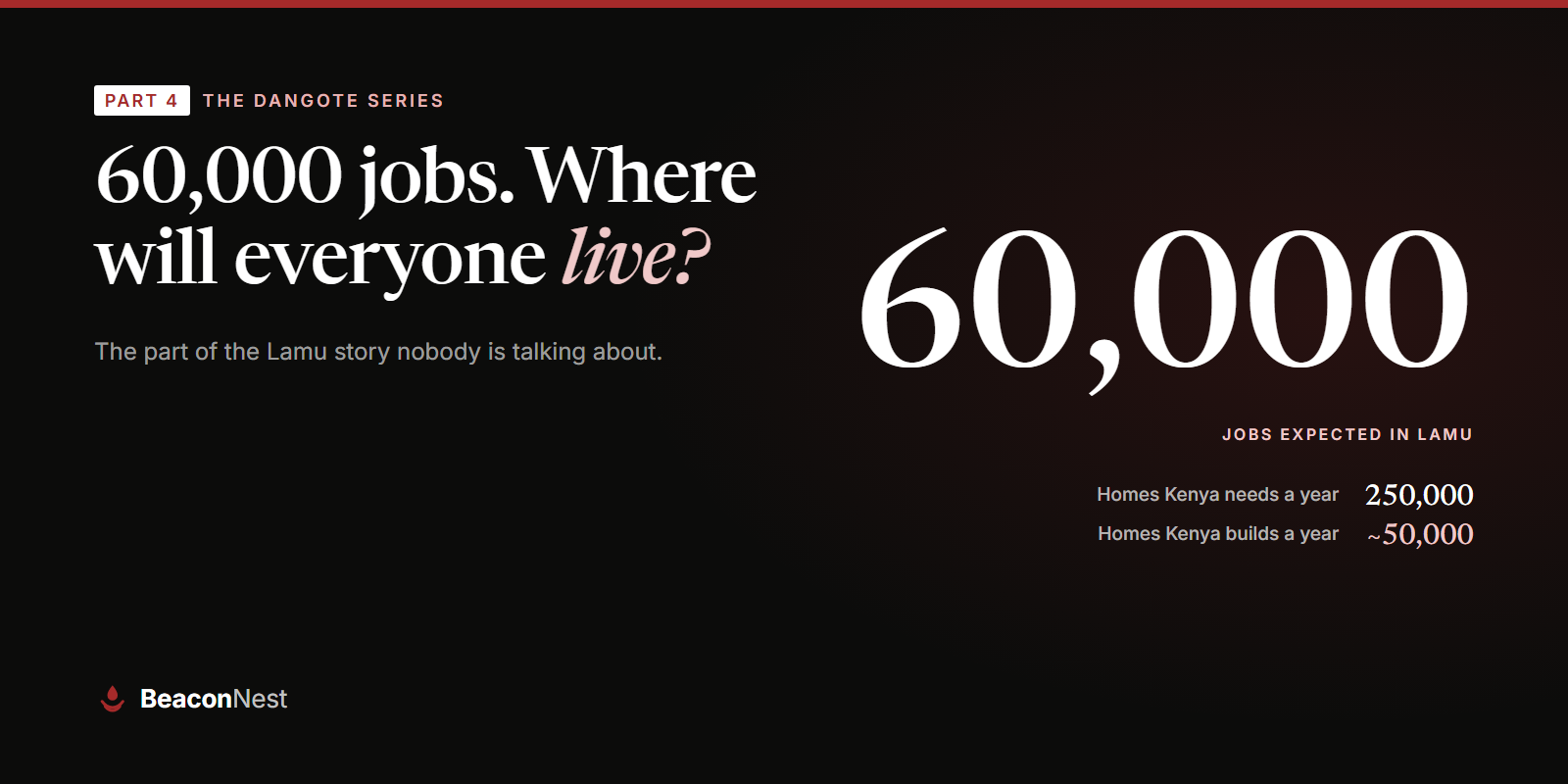
Every big project announcement comes with a jobs number. For Lamu, it is 60,000.
Jobs numbers make headlines. Housing numbers rarely do. But every one of those jobs belongs to a person who needs somewhere to live, and many of them will bring families, or send money home to one.
National figures are widely cited government and industry estimates. Sources at the end of this article.
The question nobody is asking
Lamu’s governor, Issa Timamy, put it plainly at the groundbreaking:
“A lot of people in Kenya and elsewhere will be moving to Lamu for job opportunities and investment. All these people, we require to provide for them food, to ensure there is accommodation.”
Governor Issa Timamy, Lamu County, as reported by The Eastleigh Voice.
He also said something that matters to anyone who builds: “Already, Lamu is a beneficiary of affordable housing, but we need more.” And he has promised that development plans submitted to the county will be approved within 21 days.
Who is actually coming?
It helps to think about the workforce in waves, because each wave needs a different kind of home.
-
The construction wave
Thousands of workers for three to five years. Contractors often house many of them in camps. The rest look for affordable rooms and shared housing nearby.
-
The skilled and professional wave
Engineers, supervisors, managers and specialists. They need decent apartments with reliable water, power and internet, and often bring families.
-
The service economy
Traders, transporters, caterers, security, teachers, health workers. The people who follow every large project and stay long after it is built.
-
The operations workforce
A smaller, permanent team that runs the refinery, the port and the industrial zone for decades. This is the long-term housing market.
The boom-and-bust risk
This is where many investors get it wrong.
Construction employment is temporary. It rises, peaks and falls. Housing built purely for the construction peak can end up half empty once the cranes leave.
The smart question is not “how many people will be here next year?” It is “how many people will still be here in ten years, and what can they afford?”
The permanent workforce, the port, the Special Economic Zone and the service economy around them are the real long-term market.
What good worker housing looks like
Across Kenya, the housing that works for ordinary working people has a few things in common:
- Close to work, or on a reliable, affordable transport route
- Clean water, reliable power and proper sanitation
- Safe, secure and well managed
- Rent that fits real wages, not hopeful ones
- Built to last, with maintenance planned from day one
- Room for families, schools and shops nearby
None of this is glamorous. All of it is what separates a housing project that fills and stays full from one that struggles.
This is not just a Lamu story
Lamu makes the pattern easy to see, but the pattern is everywhere in Kenya.
Wherever jobs grow, along the Nairobi Expressway, around industrial parks, near ports and new towns, demand for decent, affordable homes grows with them. And Kenya is already short of homes. The widely cited estimate is that the country needs around 250,000 new homes a year but builds only about 50,000.
The shortage is not at the top of the market. It is in well-built, fairly priced homes for the ordinary mwananchi: the teacher, the nurse, the driver, the technician, the young family.
Where Beacon Nest stands
This is the part of the market we are building towards.
Beacon Nest’s long-term goal is to develop apartment blocks that ordinary Kenyans can afford, in places where demand is real. Not because it sounds good, but because the numbers and the need point the same way.
We do not have a Lamu project, and we will not pretend otherwise. What we do have is a way of working: test the demand, the land, the cost of building and the rent people can actually pay, before anyone commits capital.
Infrastructure creates jobs. Jobs create demand for homes. The question is who builds them, and whether they are built properly.
The most important building in any boom town is not the factory. It is the home the workers go back to at night.
Get the next one in your inbox.
Research and commentary on Kenyan property, infrastructure and investment. One email when something new is published. No spam.
Not sent
Please try again, or email info@beaconnesttradings.com.
You are subscribed.
The next Beacon Nest Insight will come straight to your inbox.
- Part 1Dangote in Lamu: why it is a corridor story
- Part 2Dangote shares on the NSE: what Kenyans should check before buying
- Part 3Where will the crude come from?
- Part 460,000 jobs: where will the workforce live?You are reading this
- Part 5What happened around the Lagos refinery, and what Kenya can learn
This article is general commentary as of 30 September 2026. It does not describe a Beacon Nest project in Lamu and is not investment advice.