What happened around the Lagos refinery, and what Kenya can learn.
Kenya is not the first place to watch a Dangote refinery arrive. Lagos has been living with one for more than a decade. What happened around it is the best guide we have to what may happen around Lamu.
When Kenyans look at Lamu today, Nigerians have a sense of déjà vu.
The same founder. The same scale. The same promise of jobs and transformation. And, around the Lagos refinery, a decade of real evidence about what actually happens when a project like this lands.
Sources at the end of this article.
Lesson 1: It takes longer than announced
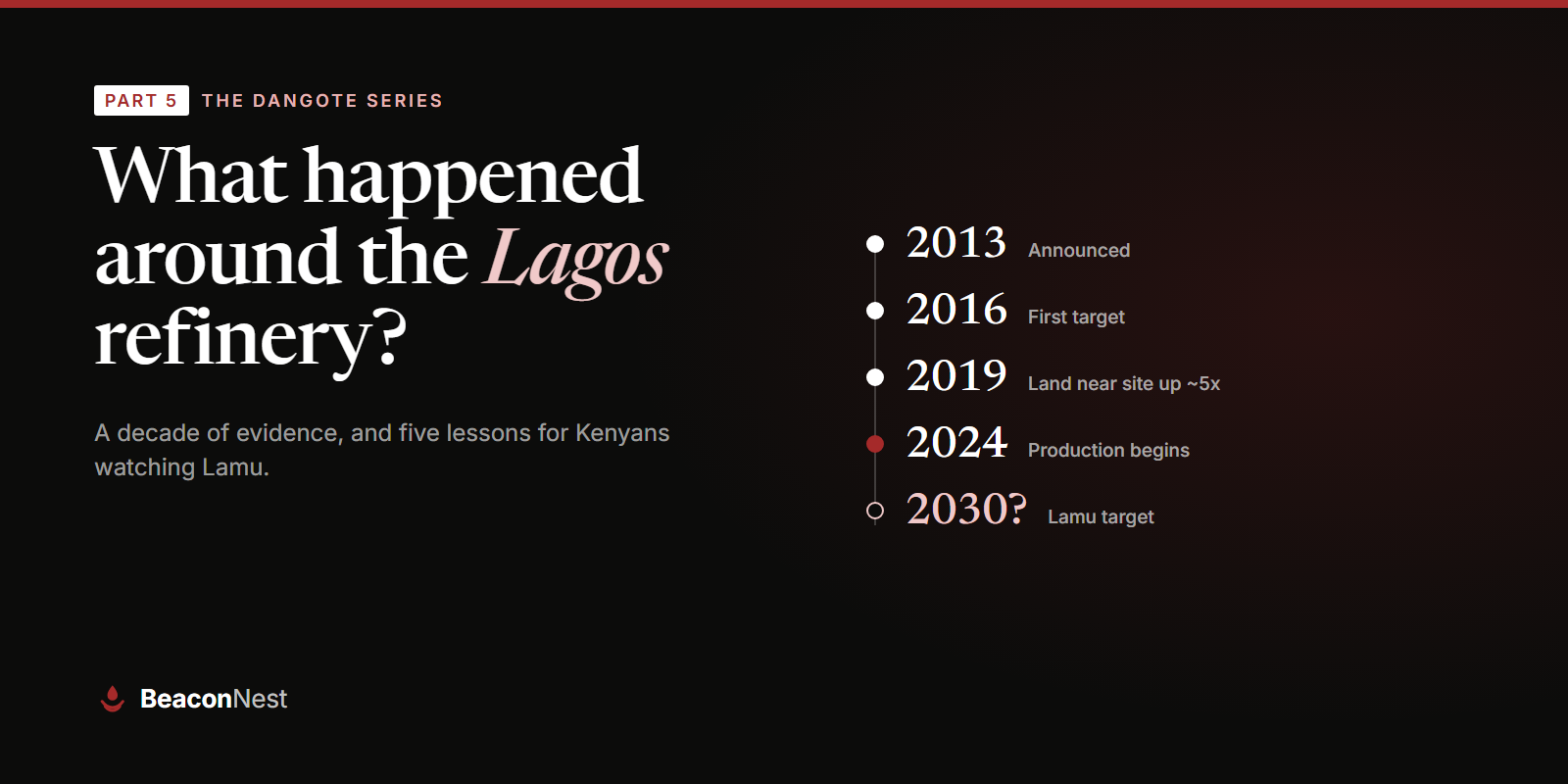
The Lagos refinery was announced in 2013 with a start date of 2016. Production began in 2024, eight years later than first promised. The cost more than doubled along the way, from an early estimate of around $9 billion to more than $19 billion.
None of this was a failure. The refinery was built, and it has changed Nigeria’s fuel market. But anyone who made plans around the 2016 date waited a very long time.
For Lamu, the target is around 2030. Plan for the possibility that it takes longer.
Lesson 2: It was never just the refinery
The refinery sits in the Lekki Free Trade Zone, alongside the Lekki Deep Sea Port. Together they turned a coastal stretch east of Lagos into an industrial corridor.
The port alone is projected to support more than 170,000 jobs over its 45-year concession. The combined effect has driven demand for worker and professional housing, warehouses, offices, shops and hotels.
This is exactly the corridor effect we described in Part 1. In Lagos, the port, the free zone and the refinery reinforced one another. In Lamu, the port is already operating and the Special Economic Zone is planned. That combination is what to watch.
Lesson 3: Land moved early, and fast
Land prices around Ibeju-Lekki rose sharply, and much of the movement happened years before the refinery produced a single litre.
A 2019 report found land close to the refinery selling for ₦6 to 7 million, against ₦1.2 to 1.5 million the year before. Estate Intel reported average land price growth of 55.9% in the Lekki area over the five years to 2023.
Early buyers in the right locations did well. But “right location” turned out to matter enormously.
Lesson 4: Infrastructure lagged behind the hype
Roads did not keep pace. The Lekki-Epe expressway was still under construction as traffic surged. Tanker trucks from the refinery and the port added to the pressure.
Industry analysts also warned that fumes and soot from the refinery could make some nearby areas less appealing for homes, even with the planned separation of uses in the free zone.
Being close to a refinery is not the same as being in a good place to live. Access, services and environment decide which land holds its value.
Lesson 5: Not everyone who bought “near Dangote” won
Wherever land moves fast, marketing moves faster. Plots far from any real activity get sold as being “near the refinery”. Buyers skip verification because they are afraid of missing out.
That is where people lose money: on land without access, land without services, land that is further than it sounded, and land where the paperwork does not survive a proper search.
Lamu is not Lekki
One difference matters more than any other.
Lekki sits next to Lagos, one of Africa’s largest cities, with more than 15 million people and a huge, established demand for land and housing. The refinery landed on the edge of an existing economic giant.
Lamu County had fewer than 150,000 residents at the last census. Its growth will depend far more on the refinery, the port, the Special Economic Zone and LAPSSET actually delivering. That means more upside if they do, and more risk if they are delayed.
What Kenyans can take from Lagos
-
Use realistic timelines
Assume the 2030 target could slip. Only commit money you can leave in place for a long time.
-
Watch the cluster, not the headline
The port, the Special Economic Zone, roads and pipelines matter as much as the refinery.
-
Buy access and title, not proximity claims
An official search, a surveyed boundary and a real road beat any “minutes from Dangote” advert.
-
Think about where people will live
Housing, services and schools follow jobs. Well-located, well-built homes tend to outlast the hype.
-
Respect community land issues
Lamu already has land claims before the courts. Understand the history of any parcel before you buy it.
The bottom line
Lagos shows that a Dangote refinery can reshape the economic map around it. It also shows that the gains go to people who are patient, careful about location and strict about paperwork.
Lamu’s story is just beginning. The lessons from Lagos are already written. The investors who read them first will make better decisions.
That is the end of our first Dangote Series. We will keep following Lamu, the corridor and what they mean for Kenyan investors as the project moves forward.
The lessons from Lagos are already written. The question is who reads them before buying.
Get the next one in your inbox.
Research and commentary on Kenyan property, infrastructure and investment. One email when something new is published. No spam.
Not sent
Please try again, or email info@beaconnesttradings.com.
You are subscribed.
The next Beacon Nest Insight will come straight to your inbox.
- Part 1Dangote in Lamu: why it is a corridor story
- Part 2Dangote shares on the NSE: what Kenyans should check before buying
- Part 3Where will the crude come from?
- Part 460,000 jobs: where will the workforce live?
- Part 5What happened around the Lagos refinery, and what Kenya can learnYou are reading this
This article is general commentary. Nigerian land price figures are drawn from the reports cited and describe specific periods and locations. Past price movements in one market do not predict future movements in another. It is not investment advice.