Buying land in Malindi: prices, areas and the checks that protect you.
Malindi is one of the most searched places to buy land on Kenya’s Coast. It is also one of the easiest places to get it wrong. This is the practical guide we wish every buyer read first, at home or abroad.
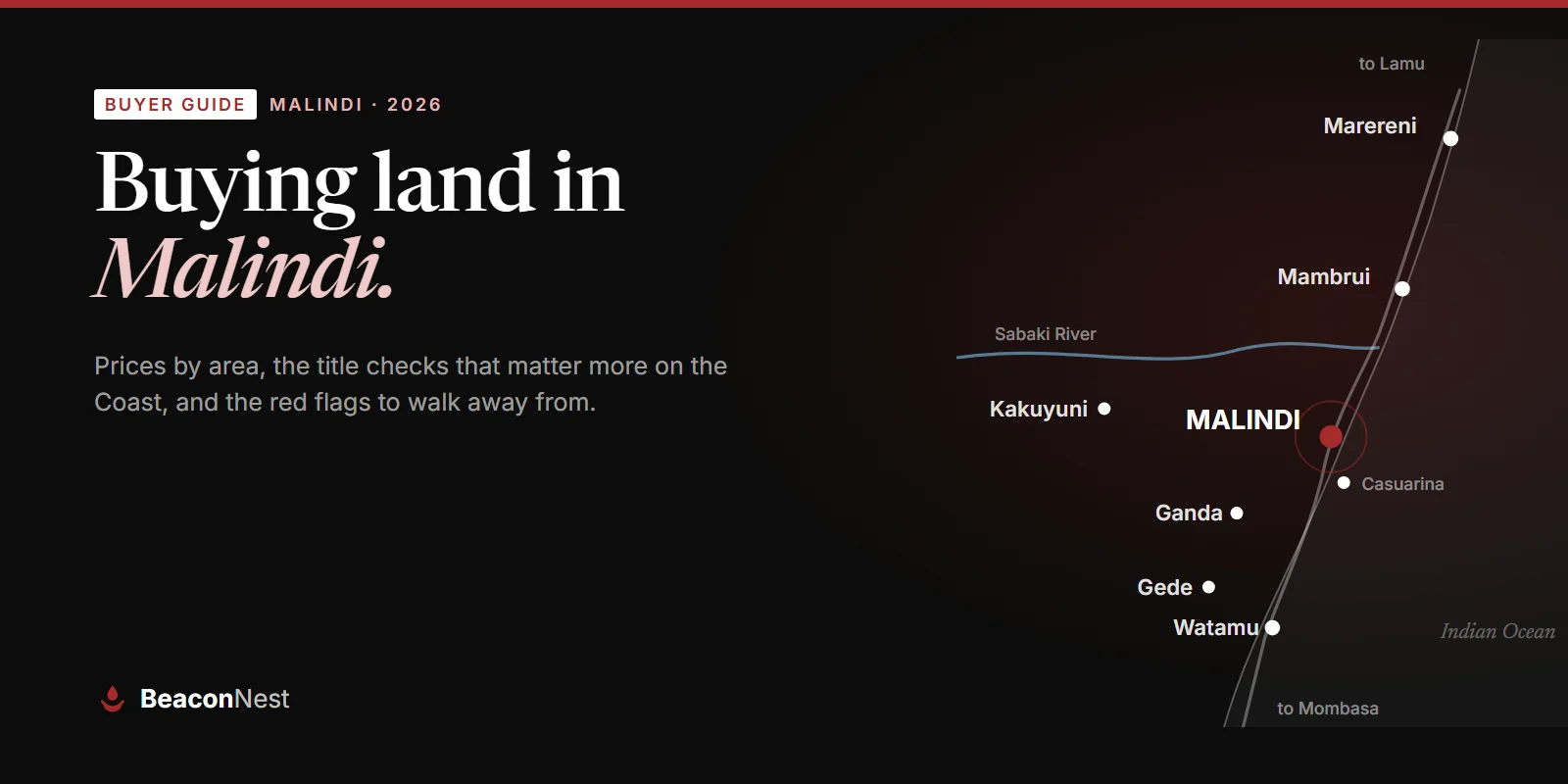
Beacon Nest graphic. Areas shown schematically, not to scale.
Ask anyone who has bought land in Malindi and you will hear two kinds of story.
The first is about a plot bought quietly, years ago, that is now worth many times what was paid. The second is about a buyer who paid in full and then discovered someone else on the land, a second “owner” with papers, or a title that never came.
The difference between the two stories is almost never luck. It is what was checked before the money moved. This guide covers what Malindi land costs, where, and exactly what to check.
Asking prices from public listings, August to September 2026. Asking prices are not sale prices. Sources at the end of this guide.
Why Malindi is on so many buyers’ lists
Malindi has long been a tourism town with a strong holiday-home market. Several things are now adding to that:
- Roads. The East African Coastal Corridor, a highway from Malindi to Bagamoyo in Tanzania, has African Development Bank financing. Its first phase dualls the road from Mombasa to Kilifi, and works have started at the Mombasa end. The Kilifi to Malindi section would come later.
- The airport. The Kenya Airports Authority plans to extend Malindi’s runway from 1.4 to 2.5 kilometres so larger aircraft, including direct flights from Europe, can land. It has been a slow project, held up for years by land compensation.
- Land services. A new Land Registry in Malindi, opened in July 2025, now serves Malindi and Magarini, so buyers no longer travel to Kilifi for every search.
- The northern corridor. Malindi sits on the coast road towards Lamu, where Dangote has just broken ground on a major refinery. We explain what that does and does not mean in our Lamu analysis.
None of this guarantees that any particular plot will rise in value. Projects take years, and some slip. But it explains why demand for land around Malindi is real.
What land costs, area by area
Prices in Malindi vary more than almost anywhere else on the Coast, because the area runs from beachfront to farmland within a few kilometres. These are asking prices we have seen in public listings. Use them to understand the range, not to value a specific plot.
| Area | What you will find | Asking prices seen |
| Watamu, beachfront | Ocean-facing land, holiday homes and hospitality | KSh 8.5M to 40M+ per acre |
| Mambrui | Beach plots north of the Sabaki River, quieter than town | Around KSh 8M per acre for beach plots |
| Malindi town & Casuarina | Residential plots close to services and the beach | Prime 1/8 acre around KSh 5M |
| Kakuyuni, Gede and the hinterland | Farmland and larger blocks inland | Around KSh 1M to 1.5M per acre |
| Marereni and Magarini | Affordable plots and large blocks further north | From KSh 125K per 1/8 acre; large blocks far lower per acre |
Within any one area, a plot on a tarmac road with water and power can cost several times more than a plot a kilometre away on a footpath. Access and services move prices as much as location does.
Why title checks matter more in Malindi
Much of the land along Kenya’s coastal strip has a complicated history. Large parcels were held for generations by absentee landlords, while families lived and farmed on them without documents of their own.
That history is still being resolved in the courts. In June 2026, more than 1,300 families in Ganda, Malindi, received ownership of nearly 330 acres they had occupied for decades, after a 12-year legal battle. The court relied on a principle called adverse possession: they had lived on the land openly for more than 20 years.
A clean title deed is necessary. In Malindi, it is not always sufficient.
If people have lived on a parcel openly for many years, they may have rights of their own, whatever the paperwork says. That is why you must see the land, and talk to the people around it, before you pay.
Understand what you are actually buying
-
Freehold or leasehold
Freehold means you own the land outright. Leasehold means you own it for a fixed term, often 99 years, and may pay annual rent. Under Kenya’s Constitution, non-citizens can only hold land on leasehold of up to 99 years, which matters for many foreign buyers in Malindi.
-
An individual title, or a share of a mother title
Many plots are sold out of a larger “mother” parcel that is being subdivided. Ask whether your plot already has its own title deed, or whether you are waiting for one. “Title processing” can take months, or never finish.
-
Agricultural or residential
Agricultural land needs Land Control Board consent to transfer. If you plan to build, check what the land is zoned for and whether a change of user is needed.
-
A title deed, not an allotment letter
An allotment letter, share certificate or sale agreement is not a title. Know which document you are being offered, and what it would take to turn it into a registered title in your name.
The ten checks before you pay
Print this list. Do every step, in this order, before any money moves beyond a refundable deposit held by an advocate.
- Get a copy of the title and the seller’s ID and KRA PIN. Names must match exactly.
- Run an official search. Check whether the parcel is on Ardhisasa yet; if not, search at the Malindi Land Registry. Confirm the owner and any charges, cautions or restrictions.
- Check the map. Get the registry index map and confirm the parcel number matches the land you were shown.
- Walk the boundaries with a licensed surveyor you appoint, and confirm the beacons.
- Look for occupation: houses, crops, graves, livestock. Ask the neighbours and the local chief who lives on and uses the land.
- Confirm access: a public road or registered access, not a path across someone else’s land.
- Check water and power nearby, and what it would cost to connect.
- Get a rates clearance from Kilifi County, and Land Control Board consent if the land is agricultural.
- Use your own advocate, not one chosen by the seller, to draw up the sale agreement.
- Pay through the advocate’s client account, and budget for stamp duty: 4% of the value in municipalities, 2% elsewhere.
Buying from abroad
Many Malindi buyers live in Nairobi, the Gulf, Europe or North America. Buying from a distance is possible, but every check above matters more, not less.
- Ask for a live video walk-through of the plot, not pre-recorded clips, and ask the person filming to show the beacons and the road.
- Appoint your own advocate in Kenya and have the search result sent to them directly.
- If someone will act for you, use a properly drafted and registered power of attorney with limited scope.
- Visit, or send someone you trust, before the final payment if you possibly can.
Red flags
- A price far below the area, with no clear reason
- “Title processing” with no date or document
- A seller who discourages an official search
- No site visit allowed, or only at night
- People living on the land who “will be moved”
- “Near Lamu” or “near Dangote” with no distance given
On the last point: we looked at what happened to land buyers around Dangote’s refinery in Nigeria in Lessons from Lagos. The short version is that location claims are cheap, and access and title are everything.
The bottom line
Malindi can be a good place to buy land. The road, airport and registry improvements are real, and the Coast’s economic map is changing. But Malindi rewards careful buyers and punishes rushed ones more than most places in Kenya.
Buy the title, the access and the neighbours’ agreement first. The view, the price and the potential come second.
Get the next one in your inbox.
Research and commentary on Kenyan property, infrastructure and investment. One email when something new is published. No spam.
Not sent
Please try again, or email info@beaconnesttradings.com.
You are subscribed.
The next Beacon Nest Insight will come straight to your inbox.
This guide is general information as of 1 October 2026, not legal or investment advice. Prices are asking prices from public listings and change often. Always appoint your own advocate and surveyor before buying land.